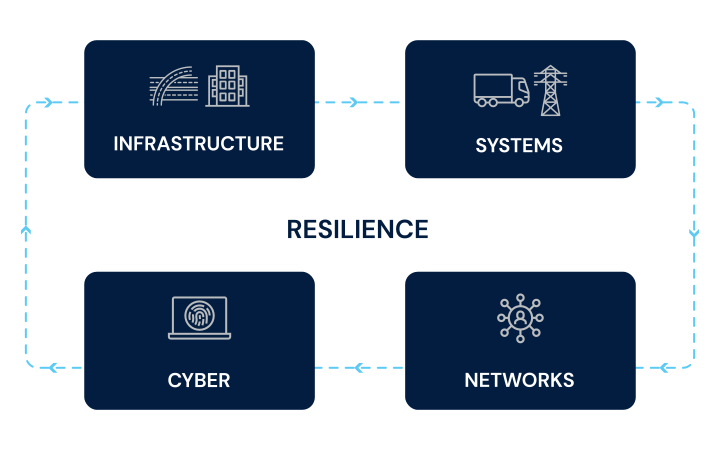
Public, private, and nonprofit organizations must develop and implement new strategies to not only prepare and respond but to also quickly recover from disasters.
Community Planning and Capacity Building
Community planning and capacity building sets direction and synchronizes activity across the other recovery support functions. For successful recovery, local governments need to take leadership and primary responsibility for the coordinated effort across all aspects of community recovery. ICF has the community engagement and facilitation experience, multidisciplinary expertise, and strong program management qualifications essential to establish governance structures and help manage the overall recovery effort.
ICF implemented the Louisiana Road Home Program, which ultimately became the largest disaster relief program in U.S. history.
Housing
ICF's multidisciplinary housing and community development teams provide a comprehensive understanding in community development block grants; rehabilitation and reconstruction; pre- and post-disaster housing and recovery planning; and program design, training, and technical assistance. ICF also works with states to help rebuild sustainable communities that are more resilient to future natural disasters and to promote the region and its residents.
Read more about ICF's Housing solutions.
Critical Infrastructure Systems
Critical infrastructure systems in the United States are increasingly intertwined and interdependent. ICF has worked with partners across federal, state, and local governments and the private sector to assess risks, identify protective measures, and improve the protection and resilience of critical infrastructure. ICF has experience working with the electricity, oil and gas, transportation, communications, and other sectors.
Read more about ICF's Critical Infrastructure solutions.
Health and Social Services
ICF enhances community resilience to all hazards by supporting:
- Public health and medical preparedness
- Disaster behavioral health
- Disease surveillance
- Health communications and social marketing
- Health surveys and data collection
- Research and evaluation
- Training and technical assistance
ICF offers decades of multidisciplinary experience assisting organizations at the local, state, and federal levels to integrate community public health and medical considerations into all aspects of recovery. ICF's behavioral health experts provide training and technical support to assist in psychological and emotional recovery efforts.
Read more about ICF's Health and Social Services solutions.
Economic and Workforce Development
During the recovery and rebuilding phases, ICF equips city, county, state, and tribal governments and nonprofit organizations with the skills and abilities they need to build and sustain community economic health. ICF supports stakeholders with a range of economic and infrastructure development issues focused on workforce development, asset building, economic development, and community building so that neighborhoods can achieve economic stability and maintain social equity.
Read more about ICF's Economic Development solutions.
Natural and Cultural Resources
Ecological restoration is the process of assisting the recovery of an ecosystem that has been degraded, damaged, or destroyed. ICF helps planners navigate the complex interplay of regulations and compliance issues surrounding a recovery and rebuilding effort, including environmental planning and historic preservation, issue identification and assessment, and natural and cultural resource planning, project design, and implementation. The goal is to create a self-sustaining ecosystem that is resilient to degradation as a result of human disturbance and natural disasters.
Learn more about ICF's Natural and Cultural Resource solutions.
Climate Change
A core principle of the NDRF is that recovery processes include a rigorous understanding of risks and vulnerabilities and build in sustainability and resilience. Experts have long argued that climate change will continue to exacerbate vulnerability to extreme weather. Existing infrastructure may be at risk to impacts from extreme events, like intense rainfall from storms or wind from hurricanes, as well as longer-term trends in climate such as periods of drought or heat. ICF helps decision makers understand the risks posed by climate change, evaluates vulnerabilities, and develops adaptation solutions.
Read more about
ICF's solutions for Climate Change.